Balsamic Vinegars
Olive U Naturally is proud to offer some of the world’s finest Balsamic Vinegars.
We’re here to help you decide on just the right variety for your cooking enjoyment.
|
|
|
|
|
|
|
|
|
|
|
|
|
|
|
|
|
|
|
|
|
|
|
|
|
|
|
…
Learn more about Balsamic Vinegars below.
…
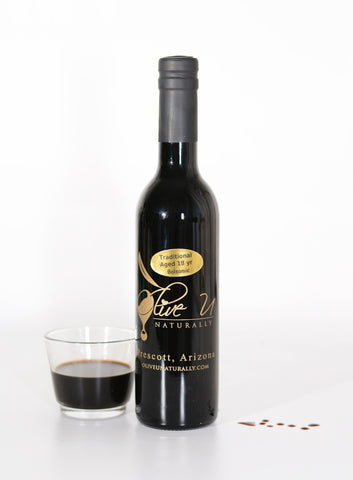
Balsamic vinegar (Italian: aceto balsamico) is a condiment originating from Italy.
The original traditional product, made from a reduction of cooked white Trebbiano grape juice and not a vinegar in the usual sense, has been made in Modena and Reggio Emiliasince the Middle Ages: the production of the balsamic vinegar is mentioned in a document dated 1046. During the Renaissance, it was appreciated in the House of Este. Today, the traditional balsamic vinegar is highly valued by chefs and gourmet food lovers.
The names “Aceto Balsamico Tradizionale di Modena” (Traditional Balsamic Vinegar of Modena) and “Aceto Balsamico Tradizionale di Reggio Emilia” (Traditional Balsamic Vinegar of Reggio Emilia) are protected by both the Italian Denominazione di Origine Protetta and the European Union’s Protected Designation of Origin.
Balsamic Vinegar of Modena (Aceto Balsamico di Modena), an inexpensive modern imitation of the traditional product, is today widely available and much better known. This is the kind commonly used for salad dressing together with oil.
The word balsamico means “balsam-like” in the sense of “restorative” or “curative”.
…
Uses
Commercial grade balsamic vinegar is used in salad dressings, dips, marinades, reductions and sauces.
In Emilia-Romagna, tradizionale vinegar is most often served in drops on top of chunks of Parmigiano Reggiano and mortadella as an antipasto. It is also used sparingly to enhance steaks, eggs or grilled fish, as well as on fresh fruit such as strawberries and pears and on plain crema (custard) gelato. Tradizionale vinegar has excellent digestive properties and it may even be drunk from a tiny glass to conclude a meal.
Contemporary chefs use both tradizionale and condimento vinegars sparingly in simple dishes where the balsamic vinegar’s complex tastes are highlighted, using it to enhance dishes like scallops or shrimp, or on simple pastas and risottos.